
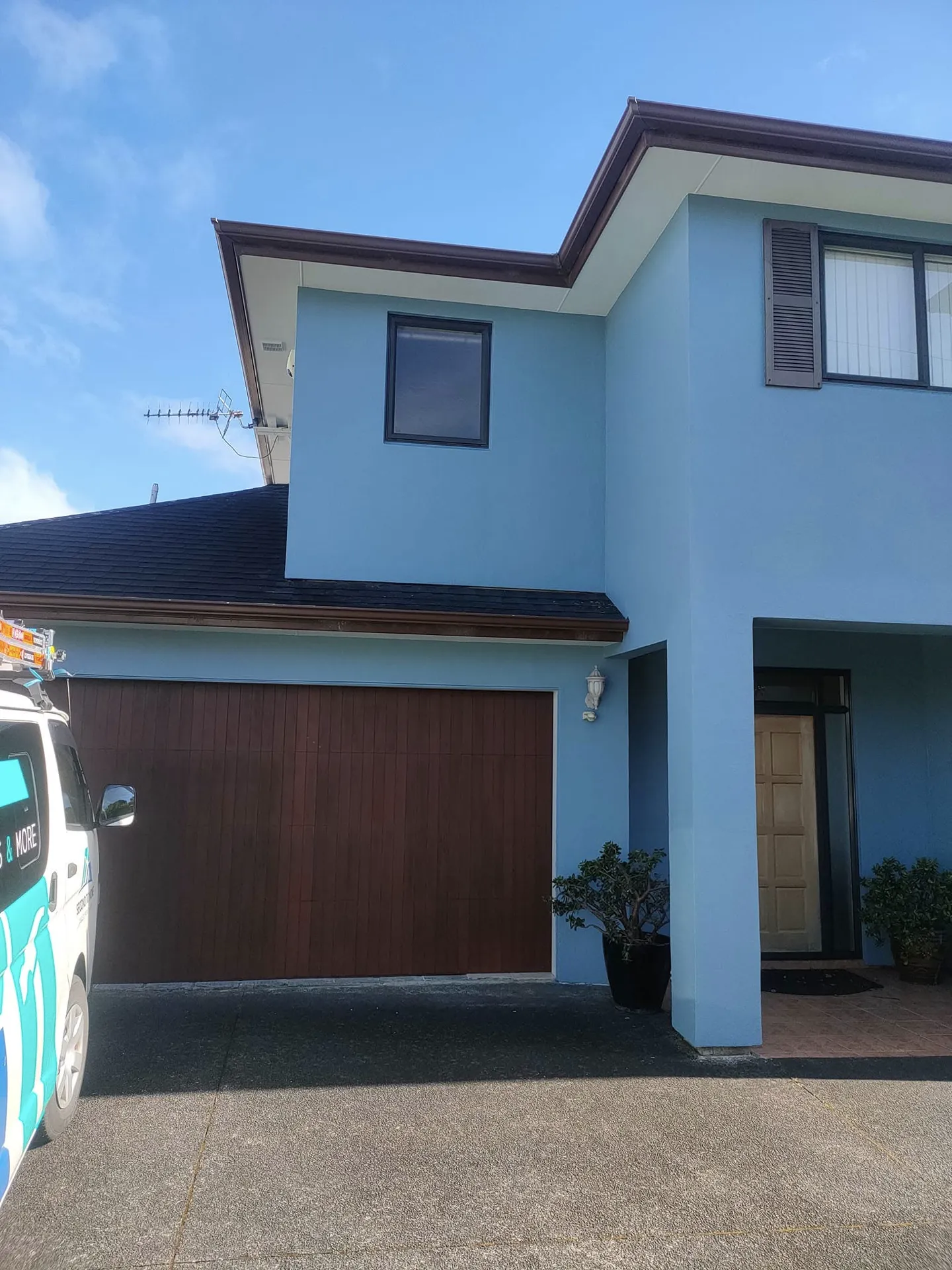
Ask five painters how often an Auckland house needs repainting and you will get five answers. Most of them will say something between seven and twelve years, which is true enough to be useless when you are standing in front of your own place trying to work out whether this is the summer.
The honest answer is that the calendar is the least important part of it. What decides your repaint cycle is what the house is made of, which way it faces, how well the last coat went on, and how close you are to the sea.
The rough guide, and why it is only rough
For a typical Auckland home, here is where most exteriors land:
| Surface | Typical repaint window |
|---|---|
| Weatherboard, sheltered | 8 to 12 years |
| Weatherboard, exposed or coastal | 5 to 8 years |
| Plaster and stucco | 10 to 15 years |
| Fibre cement cladding | 10 to 15 years |
| Joinery, sills and trim | 4 to 7 years |
| Decks and handrails | 2 to 4 years |
Notice how far apart the top and bottom of that table are. A villa in Mt Eden tucked behind mature trees and a bungalow in Milford taking the full southwesterly are the same age and the same material, and one of them will need doing twice as often.
What actually drives it
Salt
If you can smell the sea from your letterbox, take two to three years off every number above. Salt does not just sit on the surface. It works into micro cracks in the film, holds moisture against the substrate, and lifts the coating from underneath. Devonport, Milford, Mission Bay, Herne Bay, Titirangi's western faces, anywhere on the coast, the paint is working harder than the label ever assumed.
Which way the wall faces
North and west walls take the UV. That is where you will see chalking first, where the colour goes flat and leaves a dusty film on your hand when you rub it.
South walls take the damp. That is where you get the black and green growth, especially under eaves and behind shrubs where the wall never really dries out.
It is common for one elevation to genuinely need doing while the other three have three or four years left. There is nothing wrong with painting one side of a house. It is often the smartest money you can spend.
What went on last time
This is the one nobody wants to hear. A repaint done properly, with the right preparation, the right primer on bare timber and two full coats of a quality exterior acrylic, will outlast a rushed job by years, on the same house, in the same weather.
If the last coat went straight over chalky, unwashed, unprimed surfaces, it is borrowing time from the next one.
The signs worth acting on
You do not need to guess. The house tells you.
- Chalking. Rub a dry hand across a sunny wall. Pigment on your palm means the binder has broken down and the film is thinning.
- Hairline cracking that runs with the grain. Early stage. Still recoverable with preparation.
- Flaking or peeling at board ends and around fixings. Moisture is getting behind the film. This one moves fast.
- Growth you have to wash off more than once a year. Not the end of the world on its own, but it means the surface is holding water.
- Timber that gives slightly under a screwdriver, especially at sill corners and the bottom of weatherboards. Stop reading and get it looked at. This is no longer a paint problem.
- Gaps opening at scriber joints and around joinery. Sealant has a shorter life than paint and it is the first line of defence.
The thing that actually costs money
Paint is cheap relative to timber. A repaint that happens a year early costs you a bit of money you could have spent later. A repaint that happens three years late costs you carpentry, and carpentry on an Auckland villa is not cheap.
Rotten weatherboards, soft sill corners, decayed scotia, all of it starts as a paint film that let go somewhere small and stayed wet through a winter. By the time it is visible from the footpath, the repair has usually spread further than it looks.
That is the real argument for repainting on the early side of the window rather than the late side. Not aesthetics. Substrate.
When to do it
In Auckland, the practical exterior season runs from about late October through to April, with the best conditions usually in February and March. You want surface temperatures above 10 degrees, no rain within a few hours of application, and enough dry weather beforehand that the timber is not carrying moisture.
Booking matters more than most people expect. Good crews fill their summer by about September. If you know next summer is the one, the conversation is worth having now, not in December.
A reasonable way to decide
Walk the house once, slowly, on a dry day. Look at each elevation separately. Check the sills, the board ends, the joins around joinery, and the bottom two boards where the ground splashes up.
If two or more elevations show chalking or cracking, plan the full job. If one does, plan that one. If you find anything soft, get it assessed before you plan anything, because the paint scope depends on what the repair scope turns out to be.
And if you would rather someone else did that walk, that is what we are for. Send us the suburb and a few photos of the worst-looking wall, and we will tell you straight whether you are looking at this summer or the one after.